NEW! Open-Air Tornado Simulation Chamber!
Visitors since 8/12/01
View pictures of the chamber in action
This simulator uses some everyday materials that are available either in the house, or in a nearby Radio Shack or hardware store:
www.tornadoproject.com/cellar/workshop.htm
Only modifications are the use of a small 12 VDC circulation fan available at Radio Shack and the use of an ultrasonic humidifier to make the vortex visible.
Top and bottom pieces have been added to allow the fan to be mounted and to provide a stable base to rest on the humidifier.
The humidifier's forced air duct has been partially blocked so that the mist comes out of the humidifier very slowly.
Another small improvement is the use of a laminating sheet on the top & bottom pieces to prevent water damage to the cardboard.
Here's how to build it:
Get some flat corrugated cardboard of at least 1/4 inch thick. I've found great sources of this at value stores that sell bulk items. Grocery stores and liquor stores are also good sources of clean cardboard.
Mark and cut the cardboard into 4 pieces 12" by 24". Then cut windows in two of the pieces. These windows can be any size you wish, but try to avoid making them so large so as to make the structure too weak. Then cut long rectangular slots in each piece. These slots should be 3/4" wide and 2" from the top and bottom of the sides. The slots should be about 1" from the right side of the pieces. See the diagram below:

(This image taken from The Tornado Project Homepage)
Now, cover the windows with a clear plastic sheet. Plastic food wrap works well for this. Tape the plastic wrap around the edges of the windows and pull it tight so it creates a nice window. Next, tape the four sides together so that they look like the diagram shown above. Fold the pieces so that they form a box and tape the last corner together. The finished result should look like this:

(This image also taken from The Tornado Project Homepage)
Now, here is where my design differs from that suggested by The Tornado Project. Take some more of the cardboard and cut two squares 12" on a side. Cut a 3" diameter hole in each one right in the center of the square. Now, cut 8 rectangles that are 2" by 12". Assemble and tape these parts together to look like the following picture. There should be two of these when finished.

Now, fold the edges in and tape the corners together to form a box. Each box should slip over the ends of the main chamber. OK, you have the basic chamber built..
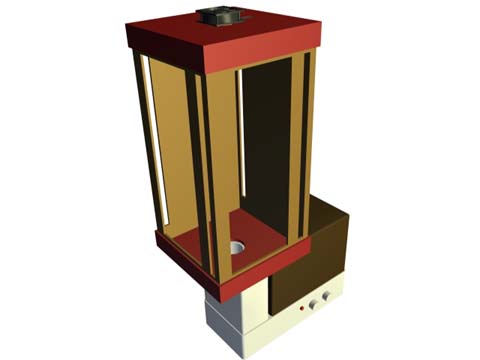
Now, to add the fan. This is a simple DC circulation fan available at Radio Shack for about $14. Attach the fan to one of the endpieces so that it is centered over the 3" hole. Make sure the fan is attached so that it blows air out of the chamber. You can attach the fan with bolts or with duct tape, or whatever works. The following picture shows the finished chamber and how it is assembled.
Well, you're obviously going to want to SEE the vortex, right? To do this, I use an ultrasonic humidifier. You might even have one of these devices already in your house. They're the humidifiers that quietly put out mist. If you don't have one, they run about $30 - $50 at almost any pharmacy. Yours will look different than the one I used, but it should still work fine.
One thing you might have to do is find some way to partially block the forced air duct on the humidifier. This is what causes the mist to shoot out of the nozzle. If you can, place some tape over the duct so that it is mostly blocked. The idea here is to get the mist to just "ooze" out of the nozzle, instead of shooting out.
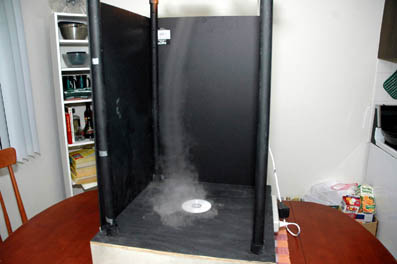
OK. Now you're ready to try it out. Put the chamber on top of the humidifier's nozzle so that mist enters the chamber through the hole in the bottom. Turn on the fan so that it runs at a very low speed. A vortex should appear within a few seconds. You might have to play with the fan speed to get a good result. The finished chamber should look roughly like this, depending on what your humidifier looks like.
View pictures of the chamber in action